In today’s cloud-dependent world, uptime is the lifeblood of business. Yet too often, enterprises accept vague service promises from vendors that leave them exposed when things go wrong.
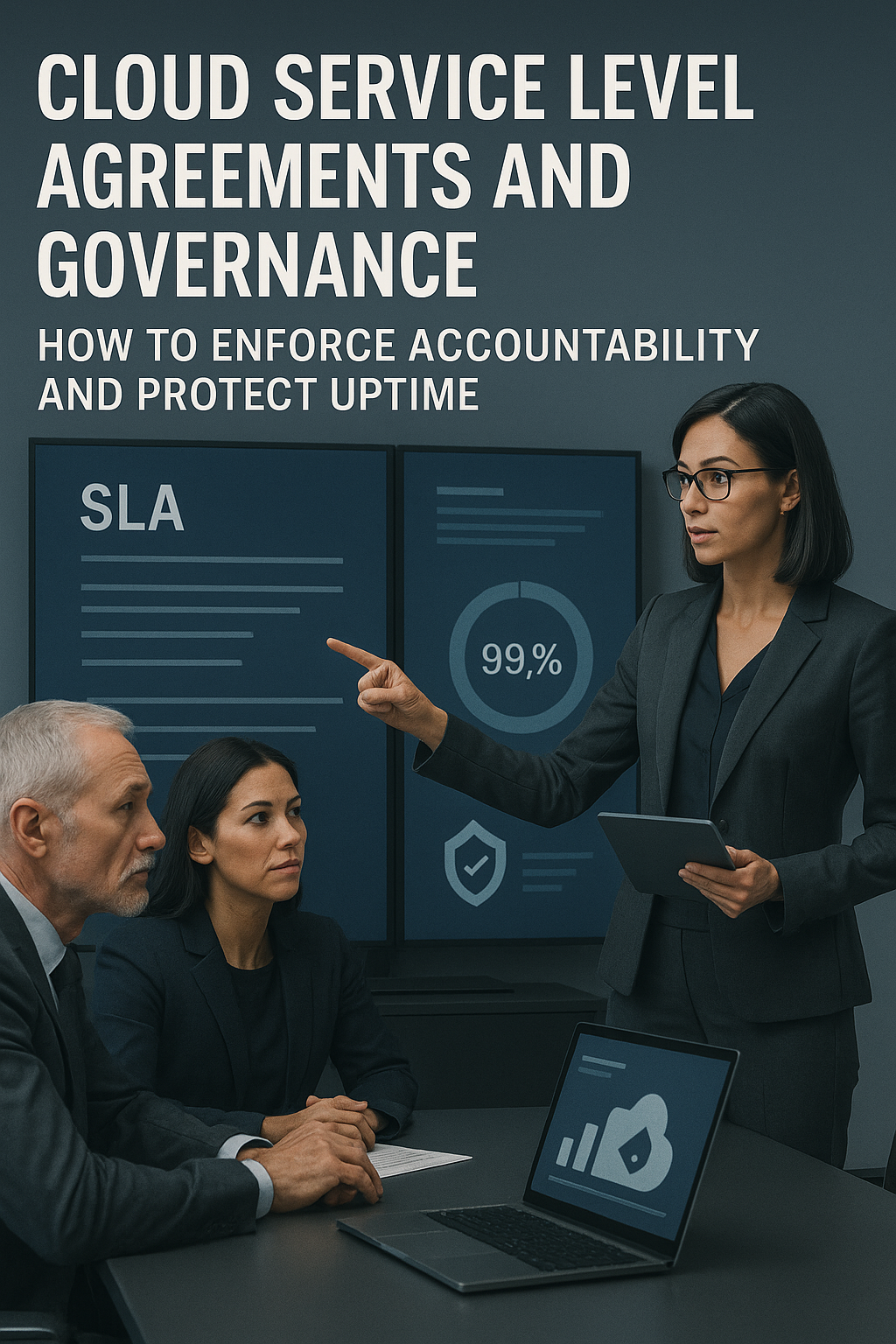
A cloud service level agreement (SLA) shouldn’t be just fine print—it must be a lever for vendor accountability. This guide explains how to negotiate rock-solid cloud SLAs and build a governance framework that keeps providers honest.
You’ll learn how to convert fuzzy assurances into binding commitments, monitor SLA performance continuously, and ensure you get the reliability and service quality you’re paying for.
Read our strategic guide, Cloud Negotiation Strategies – How to Control Spend and Protect Flexibility in Cloud Contracts.
Why Weak SLAs Put You at Risk
Cloud performance issues aren’t hypothetical – many organizations experience service slowdowns or outages every week. When services fail and your SLA is full of wiggle words, you’re essentially powerless. Providers often use “best effort” language that sounds reassuring but is, in reality, a loophole.
Without specific metrics and obligations, a vendor can miss targets with few real consequences.
In practical terms, a weak SLA lets the provider off the hook, while you scramble to deal with the fallout. Strong SLAs, on the other hand, transform vague promises into clear, enforceable commitments that protect your operations when incidents happen.
The Hidden Cost of Trusting Vendor Promises
Many companies assume that a major cloud vendor’s platform “just works” and don’t push back on the standard terms. This trust can be costly. When an outage occurs, the cloud uptime guarantees in a generic SLA might only offer minimal service credits – often mere pennies on the dollar compared to your actual business losses.
For example, a multi-hour outage could cost your business millions in lost revenue or productivity, but the default compensation might be a few thousand dollars credit toward your bill. The root cause of this gap isn’t just the downtime itself – it’s weak negotiation and lack of governance. In short, trust is not a control mechanism.
A contract with teeth is. By negotiating stronger SLAs up front and enforcing them through governance, you ensure the vendor shares the risk when their service underperforms.
What a Strong Cloud SLA Looks Like
An effective cloud SLA spells out exactly what service performance you expect and what happens if the vendor fails to deliver.
Key elements include:
- Uptime guarantees: High-availability targets (e.g., 99.9% or better) are clearly defined, often per region or service. This sets a measurable cloud uptime guarantee (for instance, 99.9% uptime means less than about 45 minutes of downtime per month).
- Performance metrics: Concrete thresholds for service quality, such as maximum response times, transaction throughput, or latency. These ensure the service isn’t just “up” but performing well.
- Support response times: Commitments to how quickly the provider will respond to critical issues (for example, 15–30 minutes for P1 emergencies). This holds the vendor accountable for resolving incidents quickly.
- Maintenance windows: Defined maintenance periods with advance notice requirements (e.g., at least 7 days’ notice for any planned downtime). This prevents surprise outages from “scheduled” maintenance.
- Remedies for breaches: Meaningful consequences when the vendor misses the SLA, such as service credits, fee reductions, or even contract termination rights for repeated failures. The remedies should scale with the severity of the breach.
In short, a strong SLA is measurable, specific, and enforceable. It turns nebulous assurances into binding commitments. Remember, an SLA only has value if you can verify the metrics and enforce the penalties – otherwise it’s just paper.
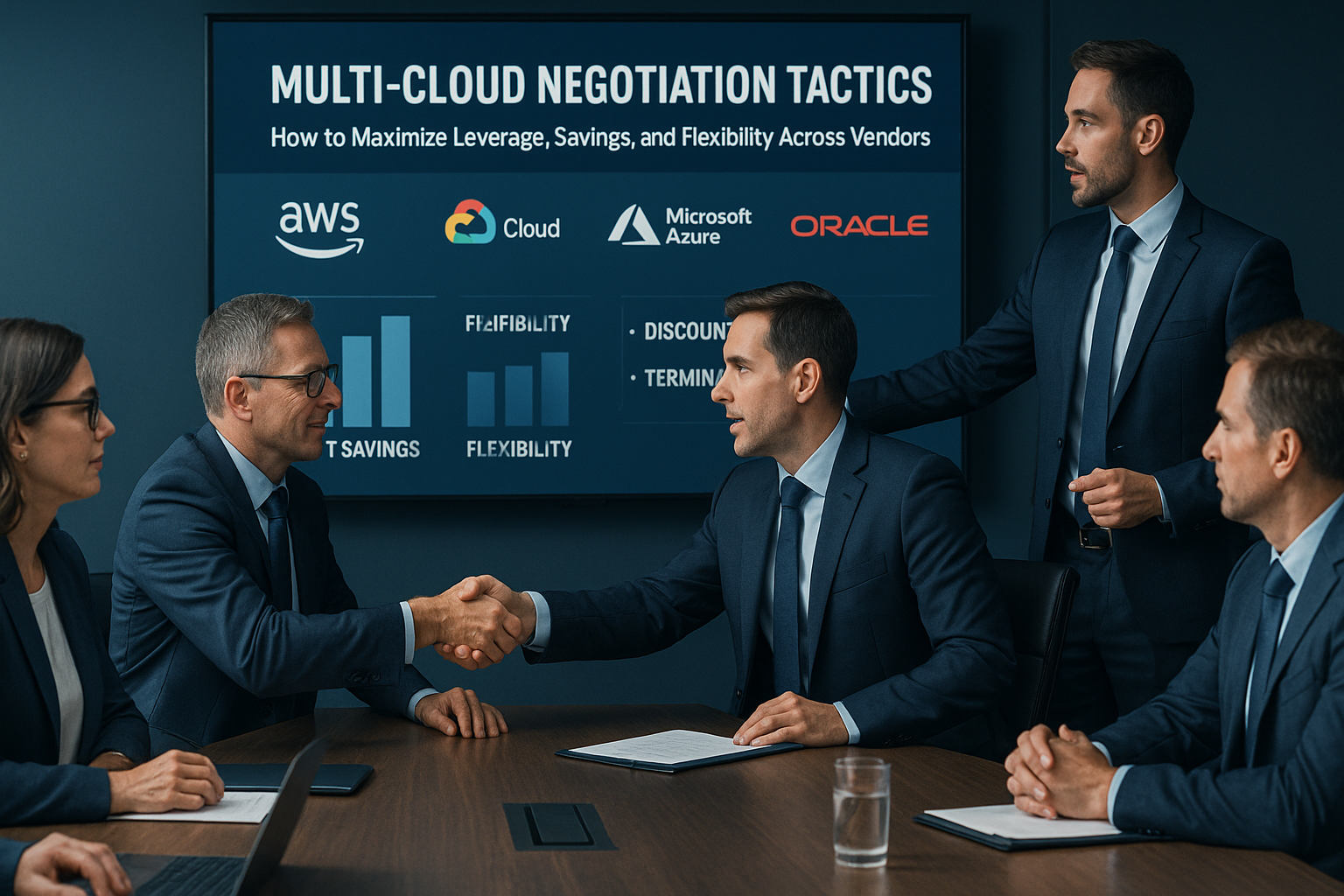
Read what multi-cloud negotiation strategies work, Multi-Cloud Negotiation Tactics – How to Maximize Leverage, Savings, and Flexibility Across Vendors.
Real-World Benchmarks for SLA Negotiation
What targets should you aim for? While every business has unique needs, enterprise-grade cloud SLA negotiation usually yields performance standards far above the provider’s boilerplate offer.
As a baseline, many large enterprises negotiate roughly the following:
- Uptime: Around 99.95% or higher for mission-critical services (this equates to only ~22 minutes of allowed downtime per month, tighter than a standard 99.9% SLA).
- Support response: 15 minutes or less response time for high-severity incidents, with rapid escalation procedures. You want assurance that critical tickets get immediate attention.
- Service credits: Typically, 5–10% of the monthly fee is credited per violation of the SLA metric, often capped at 50% of the monthly fees in a given month. The goal is to ensure credits meaningfully offset the pain of outages (and incentivize the vendor to avoid repeats).
- Maintenance notice: At minimum, 1–2 weeks’ advance notice for any planned maintenance downtime. No more surprise midnight updates that catch your team off guard.
These benchmarks reflect what savvy customers demand. Use them as a starting point and push for even better terms in areas where your risk is highest. For example, if an application is revenue-critical, you might insist on 99.99% uptime or larger credits for breaches. Don’t be shy – cloud providers will often improve SLA terms if it means winning or keeping your business.
Negotiating Remedies and Enforcement Clauses
A common mistake is focusing only on uptime percentages and forgetting the remedies.
An SLA without strong enforcement provisions is a paper tiger. Simply getting a 10% credit for a major outage isn’t enough—you need terms that truly hold the vendor accountable.
When negotiating your cloud SLA, consider adding clauses that put real teeth into the agreement:
- Automatic credits: Ensure that if an SLA breach occurs, the service credit is applied proactively without you having to chase it. If you must manually file a claim for a credit, it’s adding insult to injury.
- Cumulative penalties: Structure credits or penalties to escalate with repeated violations. For instance, a second downtime incident in a quarter could trigger a larger credit than the first. This deters chronic underperformance.
- Exit rights for breaches: Negotiate the right to terminate the contract (without penalty) if the provider consistently fails to meet SLAs over a defined period. The mere presence of this clause puts pressure on the vendor to fix systemic issues or risk losing your business.
- Reputational clauses: In cases of major or repeated failures, require the vendor to provide detailed root cause analyses or even public disclosure of the issue. This transparency can be a powerful motivator for the provider to avoid embarrassing incidents.
If a vendor pushes back on these enforcement terms, that’s a red flag – it means they fear accountability. Stand firm. A provider confident in their service quality should be willing to accept reasonable consequences when they fall short. In fact, a cloud SLA negotiation is working in your favor when the vendor takes the performance obligations seriously.
Read how to avoid cloud vendor lock-in: Avoiding Cloud Vendor Lock-In – How to Preserve Leverage, Portability, and Pricing Power.
Aligning SLAs With Business Impact
Not every application in your portfolio needs an ultra-stringent SLA. A critical part of SLA governance is aligning service levels with each service’s actual business impact. Otherwise, you might overpay for guarantees you don’t need, or worse, under-protect a crucial system.
The solution is to tier your SLAs according to the importance of the workload:
- Tier 1 – Mission-Critical: These are customer-facing or revenue-generating systems where even a few minutes of downtime hurts the business. Target the highest reliability (e.g. 99.99% uptime or better) and fastest response times. These SLAs may cost more or require architectural redundancy, but it’s worth it for business continuity.
- Tier 2 – Business-Important: Important internal services or externally facing apps that can tolerate brief disruptions but not prolonged issues. Here, an uptime guarantee around 99.9% (with rapid support response) may suffice. You still get strong reliability, but perhaps not as tight as Tier 1.
- Tier 3 – Non-Critical: Systems used for development, testing, or batch processing, and other workloads where downtime is more an inconvenience than a crisis. For these, a basic SLA or even best-effort service might be acceptable to save costs. There’s no need to pay a premium for five-nines uptime on a test environment.
By classifying your services into tiers, you align cost with risk. You’ll invest heavily in SLA guarantees where they matter most, and avoid overspending on bulletproof guarantees for low-impact systems. This pragmatic approach ensures you get appropriate cloud uptime guarantees without breaking the budget.
Clarifying Vendor Responsibilities
One trap in cloud agreements is unclear boundaries of responsibility. Vendors sometimes exploit ambiguity between infrastructure, platform, and application layers to deflect blame during incidents. To prevent finger-pointing when something breaks, use the SLA to explicitly define who is accountable for what.
Key areas to clarify:
- What counts as downtime: Specify which types of failures or performance degradations count against the uptime metric. For example, if the vendor-provided database or network falters, it should count as service downtime, even if the virtual machine is technically running. Define downtime from the user’s perspective (service unavailable or unusable), not just the server’s power status.
- Multi-zone or multi-region setups: If the vendor offers multiple availability zones or regions, clarify how outages are measured. Are you required to architect across zones to claim uptime guarantees? Make sure the SLA doesn’t assume an unrealistic setup on your side. Likewise, if you do use multi-region redundancy, ensure the SLA accounts for regional failures (e.g. a whole region outage should count as downtime even if others are up).
- Third-party dependencies: Determine whether third-party service failures (CDNs, DNS providers, etc., used by the cloud service) are included or excluded from the SLA. Vendors often want to exclude anything outside their direct control. You may accept some exclusions, but insist on clarity. If a dependency is critical, you might negotiate a shared responsibility or at least a notification requirement.
- Escalation paths: Document the process for escalating critical issues within the vendor’s support hierarchy. For instance, after a certain period or severity, your issue should be bumped to senior engineers or management. This ensures that when you have a serious problem, it gets appropriate attention and doesn’t languish at tier-1 support.
By pinning down these details, you close the gaps through which accountability might otherwise slip. Clarity in the contract means the vendor cannot easily shrug off an incident as “not our problem.” It forces everyone to acknowledge upfront where the vendor’s responsibilities lie, which is crucial for effective SLA performance monitoring and enforcement.
Building Governance Around SLAs
Negotiating a strong SLA is only step one. Step two is governance – the ongoing process of monitoring, reporting, and enforcing those SLA terms over the life of the contract. Without governance, even the best SLA can become an unused safety net.
Build a governance framework that keeps service levels in constant focus:
- Continuous monitoring and reporting: Implement tools to track uptime and performance metrics in real time. Generate monthly reports comparing actual performance vs. the SLA targets. This regular reporting creates a documented history and quickly flags any deviations.
- Quarterly vendor reviews: Hold formal quarterly meetings with the cloud provider to review SLA compliance. Discuss any incidents, their causes, and what the vendor is doing to prevent repeats. This is also your forum to address concerns, push for improvements, or fine-tune terms if needed.
- Automated alerts: Set up alerts for when key metrics approach or drop below SLA thresholds. For example, an alert if uptime in a given week falls under 99.99% or if response time spikes beyond the agreed maximum. Early warning allows you to engage the vendor proactively and also ensures you don’t miss a breach (so you can claim credits or take remedial action immediately).
- Independent validation: Don’t rely solely on the vendor’s word. Use independent monitoring services or third-party audits to validate the provider’s performance data. This provides an objective check and can resolve disputes if the vendor’s reports don’t align with your own observations.
By treating SLA management as a continuous discipline, you transform the agreement into a living tool for performance management. Governance turns those SLA clauses from static contract language into active oversight.
In essence, SLA governance is what keeps the vendor’s promises meaningful long after the ink is dry. Remember, an SLA without follow-through is just wishful thinking, but an SLA under strong governance becomes a backbone of reliability.
Using SLAs as Negotiation Leverage
A well-crafted SLA isn’t just a defensive measure – it can also be a bargaining chip. When evaluating or renewing cloud services, make SLA quality a competitive differentiator.
Vendors will often sharpen their pencils if they know a rival is offering a better deal on reliability or support. Leverage this by:
- Comparing providers side-by-side: During vendor selection, ask each cloud provider to detail their SLA commitments (uptime, support, credits, etc.). Use these cloud SLA negotiation points in your decision matrix. A provider willing to offer a stronger SLA may be a sign of greater confidence in their service (and gives you better protection).
- Asking for SLA improvements as a condition: Don’t hesitate to request enhanced SLA terms as a “sweetener” for signing or renewing a contract. For example, if Provider A’s base SLA is 99.9%, ask if they’ll commit to 99.99% for your account, or increase the credit percentage for outages. Often, these improvements cost the vendor nothing unless they fail to perform, so they may concede to win your business.
- Timing it with renewals/expansions: Use renewal time or service expansion as a negotiation moment. If the vendor knows you are considering alternatives, they’ll be more inclined to agree to tougher SLAs or additional guarantees to secure your continued patronage. Bundle your ask for better SLA terms with pricing or volume discussions.
- Highlighting competitive gaps: If you have multiple cloud providers (for instance, using a multi-cloud strategy), let each know where the other’s SLA is stronger. This can motivate them to match or exceed those terms. Vendors do not want to be outdone by competitors, especially when it comes to promises of reliability and support.
In essence, treat SLA terms as part of the value proposition in any cloud deal. Providers invest heavily in uptime and support for marketing purposes; make them put it in writing where it counts.
By proactively negotiating SLAs, you turn what is often an overlooked contract element into a source of vendor accountability and a way to differentiate true enterprise-ready partners from the rest.
Integrating SLA Performance into FinOps and Cost Control
Cloud downtime isn’t just a technical issue – it’s a financial one. When a service is down or underperforming, it can directly impact revenue, incur extra costs, or, at a minimum, waste the money you’re spending on that service while it’s unavailable.
That’s why it’s important to weave SLA monitoring into your FinOps (cloud financial operations) practices and overall cost control strategy:
- Link downtime to financial impact: Track and quantify the cost of any SLA breaches. If an outage lasted 2 hours, estimate the revenue loss, productivity hit, or added expenses incurred. By translating downtime into dollars, you make the impact concrete for both your internal leadership and the vendor.
- Account for service credits: When you do receive SLA credits or refunds, capture those in your financial reporting. They are effectively negative spend. Over time, you can show how much value was clawed back via SLA enforcement. This also highlights providers that are costing you performance credits (a sign of issues).
- Include SLA metrics in dashboards: If you have cloud cost dashboards or operational dashboards, incorporate key SLA performance indicators alongside cost and usage data. For example, show the monthly uptime percentage next to the monthly spend. This gives a holistic view of cost vs. quality. A slight increase in spend might be justified to achieve higher uptime, while frequent downtime might prompt reconsideration of a supposedly “cheap” provider.
- Use data in renewal negotiations: All performance data and financial impact analyses are powerful evidence when it’s time to renegotiate. If a vendor had multiple SLA violations, you could negotiate a discount or require improved terms to compensate. Or, if they consistently met or exceeded SLAs, you might leverage that track record to get better pricing (since you plan to continue the partnership). The goal is to align the vendor’s financial incentives with performance – they know poor performance will hurt them not just in credits but in jeopardizing the contract.
By integrating SLA compliance into your FinOps framework, you ensure that technical reliability and cost efficiency are evaluated together. It’s a reminder that value isn’t just about low prices; it’s about service level delivered for the price.
Governance here isn’t just about holding the vendor to account technically, but also about ensuring the business side is monitoring the return on reliability.
5 Actionable SLA Negotiation and Governance Tactics
Finally, here are five concrete tactics you can apply to strengthen your cloud SLAs and the governance around them:
- Define Every Metric. Eliminate fuzzy terms like “reasonable effort” or “aspirational targets.” Nail down exact metrics for uptime, response time, recovery time, etc., and include clear formulas for how they’re measured. If it can’t be measured, it can’t be enforced – so get it in writing.
- Negotiate Automatic Credits. Don’t settle for an SLA that requires you to chase the provider for compensation. Insist that any SLA breach triggers an automatic service credit or fee reduction on your next invoice. If you have to ask for a credit, the SLA’s enforcement is already failing.
- Separate Uptime from Availability. Make sure “available” means fully functional for users, not just that the server is technically powered on. Define service uptime in terms of actual usability (for example, users can log in and perform transactions). This prevents providers from claiming they met the SLA when the service was technically up but effectively unusable due to partial outages or severe performance degradation.
- Review and Escalate Quarterly. Treat the SLA as a living aspect of the vendor relationship. Conduct quarterly SLA review meetings, and don’t hesitate to escalate recurring issues to higher-ups at the vendor’s side. Regular reviews create accountability and urgency. They also give you a chance to adjust terms or address new concerns proactively, rather than waiting for a contract renewal.
- Tie SLAs to Renewals. Make it clear that future business is contingent on the vendor meeting their SLA commitments. When a renewal or expansion is on the table, revisit the SLA: tighten the requirements if needed or address any gaps revealed in the past term. Vendors pay close attention when revenue is at stake, so use renewal time as leverage to reinforce the importance of SLA adherence.
SLAs are the backbone of holding cloud providers accountable – and governance is what keeps that backbone strong. By negotiating diligently up front and actively managing performance over time, you ensure your organization is protected.
You’ll not only secure better uptime and support, but also send a message to vendors: excellence is expected, and anything less has consequences. In the cloud era, that confident stance is exactly what’s needed to protect your uptime and your business.