What Is Software Contract Benchmarking and Why Does It Matter?
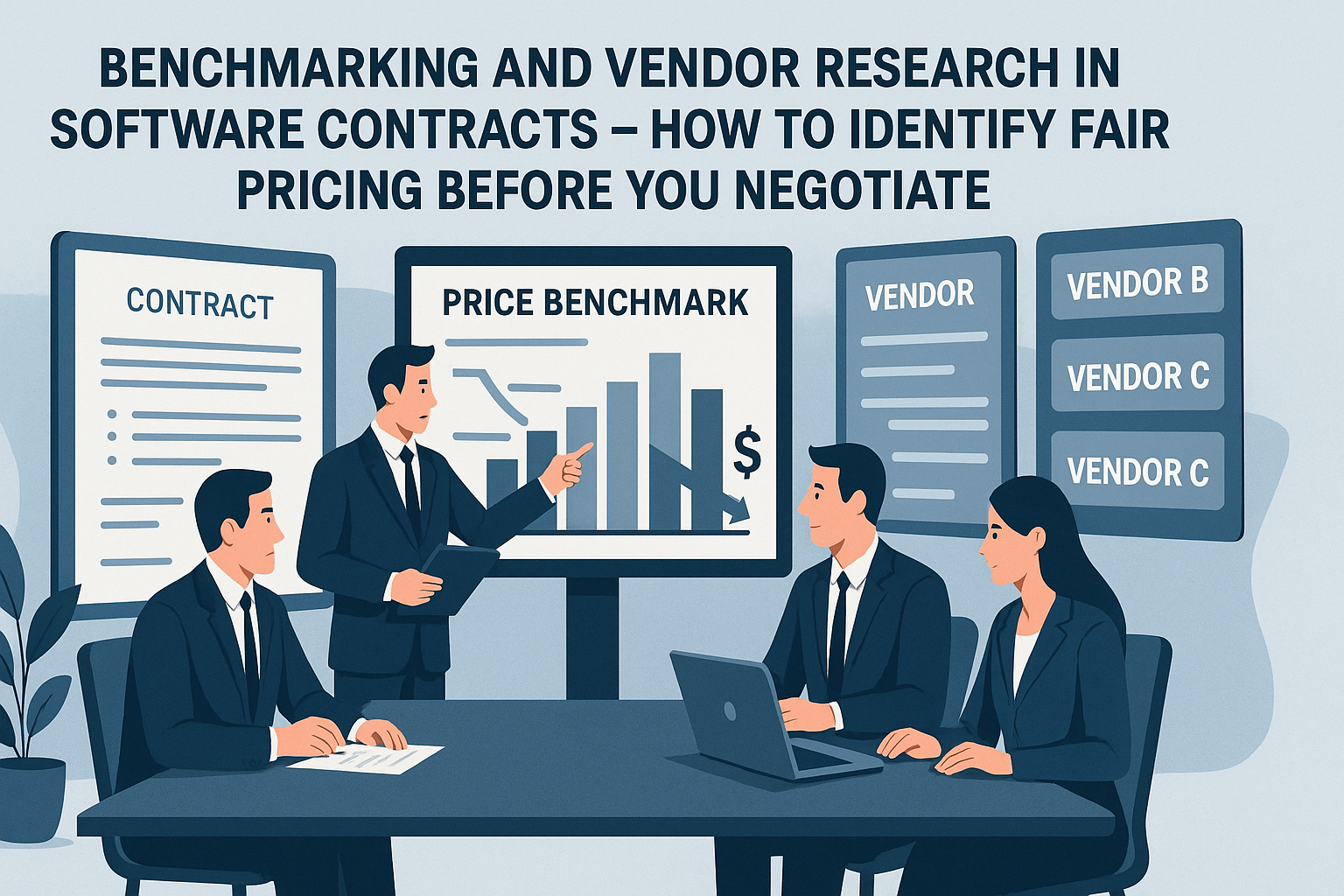
Software contract benchmarking is a form of software contract pricing analysis that compares a vendor’s stated software costs with what companies actually pay.
In practice, it means looking at real-world software pricing benchmarks—the prices and discount levels other similar customers have achieved—and using them as a reality check against a vendor’s quote. It’s how enterprises uncover inflated pricing and learn what market discounts are normal for a given product or contract size.
Without any benchmarks, you’re forced to start negotiation from the vendor’s version of reality, not the market’s. Vendors might claim a 10% discount is “standard” or that their high quote is a great deal. If you have no outside comparison, you might simply accept that.
Software contract benchmarking prevents this by ensuring you know the market-aligned software pricing. In other words, you enter talks armed with data on what “fair” really looks like, so you don’t overpay from the outset.
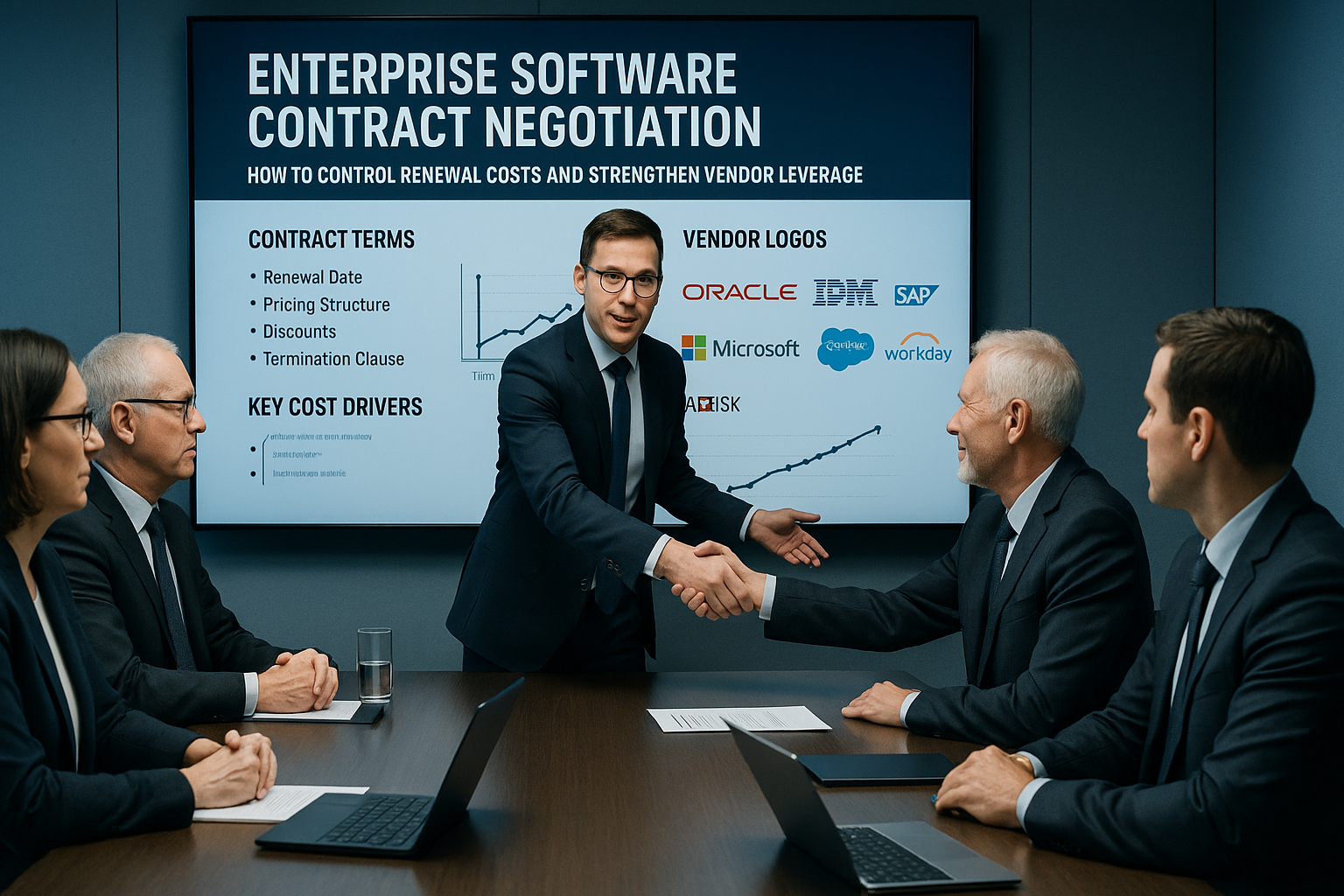
For a deeper understanding, read our ultimate guide, Enterprise Software Contract Negotiation – How to Control Renewal Costs and Strengthen Vendor Leverage.
Why Lack of Benchmarking Leads to Overpayment
Many enterprise executives admit they have limited or no visibility into what their peers are paying for the same software. This information gap benefits vendors tremendously.
If you don’t know the going rate, the vendor can float an inflated price or a meager discount, and you have little basis to challenge it.
In fact, studies have found that roughly two-thirds of executives suspect they’re paying more than their competitors – yet without data, they can’t prove it.
This lack of benchmarking data often causes companies to overpay in software deals in several ways:
- Accepting arbitrary “standard” discounts: In the absence of benchmarks, buyers often accept whatever small discount the vendor labels “standard,” unaware that the market-average discount might be much higher.
- Renewing without validating pricing: Companies may renew contracts year after year without ever checking if the pricing is still competitive. The vendor could be slipping in price increases or higher rates than what new customers pay, and you wouldn’t know.
- Paying hidden uplifts: Without benchmarks, it’s easy to pay hidden cost uplifts disguised as license changes or new modules. For example, a vendor might bundle a minor product and quietly raise the total price – and you’d have no market comparison to catch it.
In short, when you don’t benchmark, you’re negotiating in the dark. Benchmarking closes that gap by giving you factual, defensible leverage. Instead of trusting a vendor’s claims, you can counter with real data: “We know companies of our size are paying around $X per user, so your quote seems high.” That flips the power dynamic and forces the vendor to justify their price in the face of market evidence.
How Software Contract Benchmarking Works
Software contract benchmarking isn’t just about comparing list prices – it’s a structured approach to analyze all the key components of a software deal. By breaking a contract down into its core elements, you can benchmark each piece against market norms.
Effective software contract benchmarking analyzes several factors:
- Pricing: What is the list price versus the net price paid per unit (user, license, or module)? This shows how much discount is actually being achieved off the sticker price.
- Discounts: What percentage discount from the list price are similar customers getting? For example, are companies typically securing 20%, 30%, or more off this product? This helps set expectations on a reasonable discount range.
- Terms: What are the typical contract lengths and flexibility clauses? For instance, the average enterprise deal might be a 3-year term with certain termination or renewal provisions. Benchmarking terms ensures you’re not agreeing to commitments that are unusually strict or long compared to the norm.
- Support/Services: How much are others paying for support or cloud services as a percentage of license costs? Some vendors might charge 20% annual maintenance, others 25%. If you see a benchmark that support is usually 18% of license fees, you can push back if your quote is higher.
- Usage vs. entitlement: How does actual usage compare to licensed quantity in typical deployments? This can expose over-licensing. For example, if most companies use only 70% of the licenses they buy, you have room to negotiate a smaller purchase or to ensure usage rights that flex with needs.
Together, these factors define the fair market value of a software deal – essentially your baseline for what a reasonable agreement looks like. When you benchmark properly, you arrive at a reference point for negotiation. Instead of guessing or relying on the vendor’s word, you know the normal price structure and can spot outliers.
This comprehensive view of price, discounts, and terms is what you bring to the negotiation to secure a market-aligned deal.
Prepare better and read, Planning and Requirements for Software Negotiations – How to Prepare for Control and Leverage.
Where to Find Reliable Benchmark Data
To perform software contract benchmarking, you first need sources of benchmark data. Where can you find trustworthy software pricing benchmarks? The key is to pull from multiple sources—and the strength lies in triangulating across them.
Here are the most reliable sources of benchmark data, which work best in combination:
- Internal records: Start with your own house. Look at your organization’s past software contracts, renewals, and the discounts you secured historically. These give you a baseline of what you have paid and the concessions you got in the past. While internal data is limited to your experience, it’s immediately relevant and easy to obtain.
- Independent pricing databases: There are external benchmark services and databases that aggregate anonymous deal data (often provided by consultancies or procurement platforms). These databases provide a broader context—for example, average discount percentages for a given vendor or product across many companies. Subscribing to a pricing benchmark service or using reports from firms that track software deals can give you hard numbers on market averages.
- Peer networks: Tap into your professional network or industry peer groups to share information. This could be as formal as participating in a CIO roundtable or as informal as chatting with a peer at another company (under NDA or on a trusted basis) about what they’re paying. Many industry associations also facilitate anonymous surveys so members can see how they stack up. Peer benchmarking provides real-world insights, though you’ll need to ensure confidentiality and aggregate the data (no single deal tells the whole story).
- Analyst and advisory research: Advisory firms (like Gartner, Forrester, or niche IT procurement advisors) often publish aggregated trends on vendor pricing and discounting. For example, an analyst report might say “Vendor X’s enterprise customers typically get 25-30% off on renewals.” These reports can validate what you’re seeing elsewhere and add color on why (e.g., “Vendor X increased discounts last year due to competitive pressure”).
By gathering data from internal deals, third-party benchmarks, peers, and analyst research, you get a well-rounded picture. The goal isn’t to find one “exact” price—it’s to recognize patterns. Triangulate the data to spot the range of reasonable pricing.
You want to know: Are we being quoted above, below, or within the market norms? If all your sources indicate that most companies pay around $500K for a certain package and you’ve been quoted $800K, that’s a red flag. Remember, you’re not aiming for precision down to the dollar; you’re aiming to identify the ballpark in which fair deals occur.
The importance of negotiating the terms, Negotiating Licensing Terms and Conditions – How to Avoid Costly Software Contract Pitfalls.
Example: Typical Enterprise Software Discount Bands
To understand how benchmarking helps, let’s look at a simplified example. Below is a table of typical discount ranges for five major enterprise software vendors.
It shows the average discount (what many customers get off list price) versus a high benchmark range (the kind of deeper discount that the savviest customers manage to negotiate). It also notes key leverage points that often enable those higher-end deals.
| Vendor | Average Discount | High-Benchmark Range | Key Leverage Points |
|---|---|---|---|
| Microsoft | 20–25% | 35–40% | Renewal bundling, timing leverage (e.g. end-of-year deals) |
| Oracle | 35–45% | 60–65% | Competitive pressure, audit avoidance |
| Salesforce | 25–35% | 40–50% | Multi-year commitment, end-of-quarter timing |
| SAP | 10–15% | 25–30% | User count optimization, support fee review |
| Cisco | 15–25% | 30–35% | Cross-product bundling, service contract (SmartNet) optimization |
Note: These ranges are illustrative, but they reflect how discount benchmarks expose the vendor’s pricing latitude.
What do we learn here? Say you’re negotiating with Oracle, and they offer a 40% discount off the list price.
At first glance, 40% off sounds huge—but benchmarking shows Oracle often offers 60–65% off in aggressive deals. That tells you there’s potentially a lot of room left on the table. Similarly, if SAP tells you, “We only give 10% off,” you can see that top customers get 25–30%, especially by leveraging things like user counts or questioning high support costs.
These benchmarks reveal the vendor’s margin window—the space between the list price and the lowest price they’re likely to accept. This margin window is where negotiation value is created. Knowing this, you can confidently push the vendor toward the high end of the benchmark range if your deal size and circumstances justify it.
These examples illustrate the power of benchmarking: it exposes what kind of deal is truly possible, not just what the vendor wants you to think.
Armed with this knowledge, you enter negotiations with concrete targets (e.g., “aim for at least 50% off with Oracle, because others have achieved it”) rather than negotiating blindly.
How Vendor Research Complements Benchmarking
Benchmarking tells you what others are paying; vendor research tells you why a vendor might price a certain way or how far they’ll bend. In other words, pricing benchmarks give you the numbers, while vendor-specific research gives you context and strategy. Both are critical for a successful negotiation.
By studying vendor patterns and behaviors, you can anticipate their flexibility and pricing tactics. For instance, vendor research might uncover details like a company’s quarterly sales targets, new product focus, or financial pressures. These insights help explain the pricing strategy behind the numbers.
Here are a few examples of how vendor intel complements your benchmark data:
- New product lines mean bigger discounts: When a vendor is pushing a new product or module, they often have a higher discount tolerance to drive adoption. If your benchmark data shows a wide discount range, vendor research might reveal that early adopters got extra-low prices because the vendor’s strategy was to build market share. You can use that knowledge to your advantage if you’re negotiating for a newer product.
- Quarter-end (or year-end) urgency: Most software vendors have quarterly or yearly quotas. As the quarter ends, sales reps become highly motivated to close deals. Vendor research could tell you that, for example, Salesforce tends to offer its steepest discounts in Q4 when they’re trying to hit annual targets. Combined with benchmarks, this timing insight means you might schedule negotiations to align with these periods and reap a better deal than you’d get earlier in the year.
- Financial or margin pressure: If a vendor is under pressure to increase revenues or margins (perhaps their earnings reports show slowing growth), they might push for more revenue certainty in contracts. That can manifest as them preferring multi-year deals with smaller discounts, or conversely, occasionally doing a big discount to lock in a long-term commitment. Knowing the vendor’s business situation (from analyst reports or news) helps you frame your negotiation. For example, suppose Oracle really wants to avoid audits being an issue. In that case, it may offer extra concessions to customers who could switch away or raise the specter of moving to a competitor.
In essence, vendor research for software negotiations gives you the narrative behind the numbers. Maybe your benchmark says 50% off is achievable – vendor research might tell you how to get that (e.g., wait until the end of the quarter, mention a competing product, etc.).
The combination of both data and context is powerful. You not only present facts in a negotiation (“Others pay X”), but you also understand the vendor’s motivations (“I know you need deals this quarter”) to press the right buttons.
Always combine vendor intelligence with benchmarks for full context. Benchmarking alone might tell you what to ask for; vendor research informs when and how to ask for it. Together, they enable you to negotiate with a complete picture – you know the fair price and the vendor’s likely playbook.
When to Use Benchmark Data in Negotiations
Timing matters. To maximize the impact of your benchmark data, introduce those insights early—ideally before the vendor has locked you into their pricing framework if you wait until after the vendor’s quote or proposal is finalized, you’re playing catch-up to shift the conversation.
Instead, set the tone from the start that you are an informed buyer.
Here are ways to use benchmark data during the negotiation process:
- Anchor the discussion to market rates: Rather than letting the vendor anchor the price high, use your data first. For example, you might say in an early meeting, “Our analysis shows companies of our size typically pay around $Y per license.” By anchoring the talks around competitive pricing ranges, you frame the negotiation around facts, not just the vendor’s opening number.
- Challenge “standard” discounts claims: Vendors love to say things like “Our standard discount is 10%.” If your software pricing benchmarks show the standard in the market is more like 30%, call it out (diplomatically). Ask them to explain why their offer is off from the market, or simply counter with a data-backed proposal: “We’ve seen similar deals getting 30-40% off; we expect something in that range.” This challenges any unverified claims and forces the vendor to justify their pricing.
- Set internal walk-away limits: Before negotiations, use benchmark data to establish your internal price ceilings or walk-away point. For instance, if the average deal is $500K and even high-end deals don’t exceed $600K, you might set $600K as your absolute max. That way, if the vendor refuses to come near benchmark-aligned pricing, you’re prepared to walk. This protects you from agreeing to an over-market deal in the heat of negotiation.
- Keep negotiations fact-based: Benchmark data helps shift talks from emotional or sales-driven pitches to a more analytical discussion. If a sales rep tries fear-based tactics (“Prices will go up if you wait!”) or flattery, you can continually redirect to the facts: “Let’s focus on the numbers here. The market data suggests…” This factual approach often speeds up negotiations and makes them more straightforward by minimizing bluffing and posturing.
Introduce your data points as early as is practical – sometimes even in an RFP or during preliminary talks, you can hint that “we have done our homework on market pricing.” Once vendors know you’ve done your research, their leverage drops immediately.
They realize they can’t easily get away with an inflated deal because you’ll see right through it. Essentially, by the time you’re at the table, the vendor should understand that you have a clear picture of value and alternatives. At that point, the negotiation becomes about reaching a fair deal rather than whether one is possible.
Common Benchmarking Mistakes to Avoid
Benchmarking is a powerful tool, but it can be misused. As you incorporate benchmarking into your negotiation toolkit, watch out for these common mistakes:
- Collecting data too late: Timing is crucial. If you wait until after you’ve received a vendor’s proposal (or worse, after you’ve already negotiated most terms) to start benchmarking, you’ve missed the window to influence the deal. Always gather benchmark data early, ideally before or during the initial stages of negotiation. Early data means you can shape the conversation from the outset, rather than trying to renegotiate a quote that’s already on the table.
- Over-relying on a single data point: Don’t latch onto just one deal or one data source as “the truth.” Maybe you heard a peer got a 50% discount from Vendor A—that’s useful, but it might be due to special circumstances. Always cross-reference multiple data points and sources. Look for a range of benchmarks and consider each benchmark’s context. A single exceptionally good deal or an out-of-date data point can be misleading if taken as gospel.
- Ignoring qualitative differences: Not all deals are identical. A common mistake is to compare your situation to a benchmark deal without adjusting for differences in scope or terms. For example, your benchmark data may show a 40% discount, but those deals were all 5-year commitments with rigid terms, whereas you need flexibility or a shorter term. Contract terms, product bundles, service levels, and usage volumes all affect pricing. Make sure you’re comparing apples to apples. Benchmarking should account for qualitative factors, not just the raw numbers.
- Revealing your hand to the vendor: This is crucial – never disclose your exact benchmarks or sources to the vendor. It might be tempting to say, “We know Company X got this price,” but that can backfire. Vendors will either dispute the data, find reasons your situation is “different,” or feel challenged and dig in their heels. Plus, if they know exactly what benchmarks you have, they’ll shape their counterarguments around them. Use your data as quite leverage. You can reference market averages or ranges in general terms, but keep the specifics and the identity of benchmark sources confidential.
Smart negotiators treat benchmarking data as a secret weapon, not a shared playbook. The goal is to inform your strategy, not to provide the vendor with a blueprint of your knowledge.
Remember, the vendor likely has plenty of data on what customers pay (vendors benchmark too, using their sales data!). Your advantage is in how you use your intelligence.
Use it to steer the negotiation, correct false assertions, and hold a firm line — without handing over the evidence for the vendor to scrutinize.
In summary: gather early, trust patterns over single points, consider context, and keep your benchmark data close to the vest.
How to Build Continuous Benchmarking Discipline
Too many organizations treat benchmarking as a one-off task right before a big negotiation or renewal.
In reality, benchmarking is most effective when it’s part of ongoing vendor management. Think of it as building a muscle: doing it consistently makes you stronger and more prepared over time.
Here’s how to make benchmarking a continuous discipline within your procurement or IT vendor management team:
First, make it a routine process. For example, establish a quarterly or biannual benchmarking review. During this review, the team should gather any new data points and update internal records.
Even if you don’t have a major renewal this quarter, staying on top of trends ensures you won’t be caught off guard later.
Consider implementing a process that includes the following steps:
- Track current vendor pricing trends: Continuously monitor changes to your key vendors’ pricing models and list prices. Vendors often announce price increases, new licensing models, or changes in discount policies. Keep a log of these announcements and market news, as they will influence your benchmarks.
- Update benchmark data across categories: Add new data points regularly. If you completed a negotiation last month, record the outcome (discounts achieved, terms, etc.) as new internal benchmarks. If you come across an industry report or get insight from a peer about a recent deal, incorporate that. The goal is to keep your benchmark repository up to date and reflective of the current market.
- Record actual performance after deals: After you negotiate a contract, do a brief post-mortem. Did you achieve or beat the benchmarks you had? For example, if your target was a 30% discount and you got 35%, note that success (and what leverage made it possible). If you fell short, document why (maybe the deal had special constraints). This practice turns each negotiation into learning data for the future.
- Feed insights into future prep: Use your continuously updated knowledge base when planning upcoming negotiations. If your data shows, say, that Vendor Y’s discounts have been improving over the last year due to competition, you’ll approach the next renewal with them more aggressively. Continuous benchmarking means the latest and greatest information always informs the next negotiation.
Over time, maintaining this discipline will create a living knowledge base for your organization. Instead of scrambling to gather intel at the last minute, you’ll have a rich archive of pricing data, discount trends, and negotiation anecdotes to draw from.
This not only saves time when a negotiation arises, but also strengthens your negotiating position. Each deal you benchmark and negotiate informs the next, so you get progressively better at securing optimal terms. In the long run, a continuous benchmarking culture can significantly reduce your software spend and improve the fairness of your contracts year after year.
Key Benefits of Software Contract Benchmarking
Finally, why go through all this effort? Here are the key benefits that enterprises realize when they commit to software contract benchmarking:
- ✅ Market-aligned pricing and contract fairness: You pay a fair price for software based on actual market data, avoiding overcharges. Contracts end up reflecting true market value, so you’re not the outlier paying the highest price for the same product.
- ✅ Improved negotiation confidence and control: Walking into a negotiation with solid benchmarks boosts your confidence. You have facts on your side, which lets you take control of the dialogue and push back against vendor assertions. The negotiation becomes less of a nervous guessing game and more of a structured business discussion.
- ✅ Data-backed responses to vendor pressure: When a vendor applies pressure like “This deal is only good until Friday” or “Our hands are tied on price,” you can respond with data rather than emotion. Benchmarking arms you with credible information to counter sales tactics and keep the conversation grounded in reality.
- ✅ Faster, cleaner decision-making during renewals: With benchmarks at hand, your internal approvals and decisions can happen faster. You can quickly assess if an offer is good or bad, without prolonged internal debate, because you have objective data. This leads to cleaner, more efficient renewal processes – no more eleventh-hour panic or haggling in the dark.
In short, benchmarking removes the guesswork. It turns software negotiation from a shot-in-the-dark into an informed business exercise. Deals are no longer driven purely by who has the louder voice or clever tactic; transparent data and clear value justification drive them. That means better outcomes for your organization’s bottom line and a more professional, fact-based relationship with vendors.
Final Takeaway
Every software vendor negotiates with data on their side. Benchmarking ensures you do too. Vendors know what every other customer has paid; they have entire teams analyzing deal history to optimize their sales tactics. To level the playing field, you need to bring your own data to the table.
When buyers understand market pricing, typical discount norms, and the vendor’s motivations, they stop reacting blindly and start negotiating from a position of strength. That’s the essence of true contract control – knowing what “fair” really looks like and refusing to settle for anything less.
With thorough benchmarking and vendor research, you shift the power in negotiations back to your side, ensuring every software contract your company signs is priced right and justified by real value.